I. Reimagining Carbon Commodification
The universalization of Geographic Information Systems (GIS) to map land uses and land covers is a growing topic of concern in political ecology. The scrollbar illustration on the right alludes to this problem. One of the major issues is that geospatial technologies and applications can reduce culturally and geographically distinct places into universalized landscapes for commodity exchange. Dr. Osen’s research contributes to these conversations by integrating indigenous meanings of place-making to recenter agency.
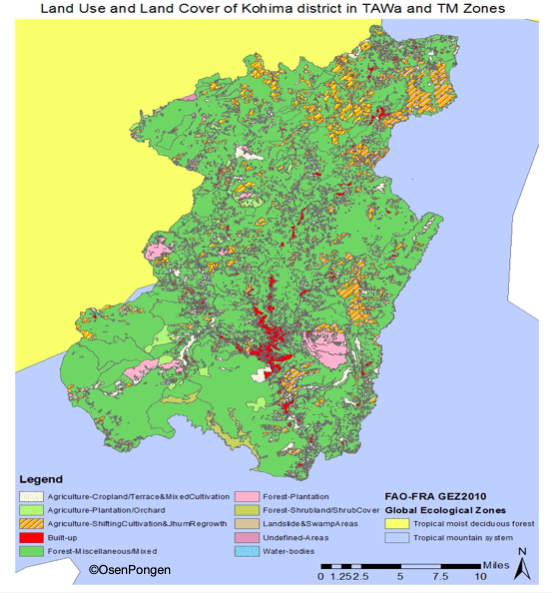

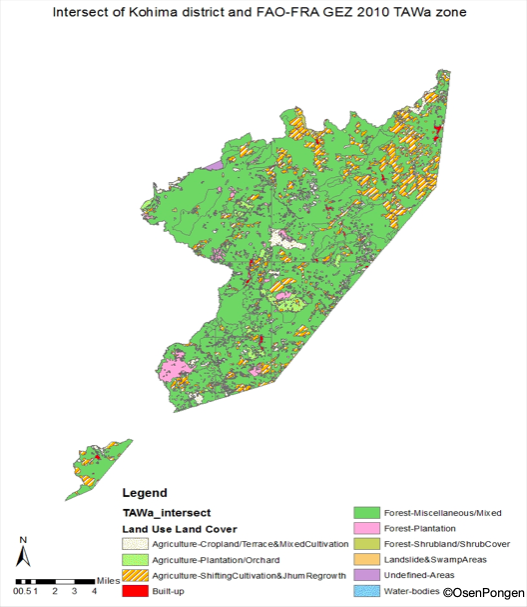

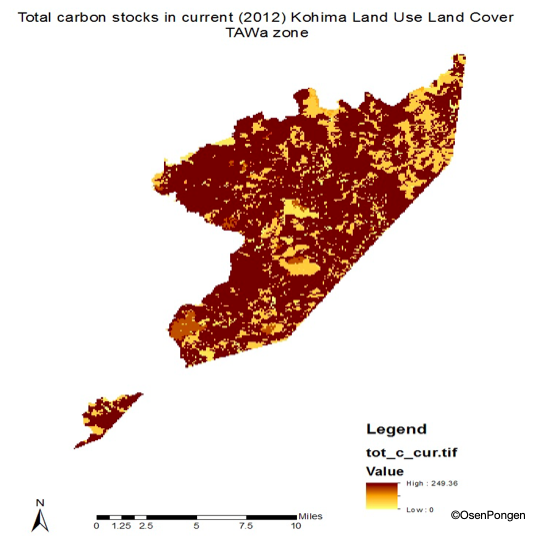

For the study, he performed platform experimentation on the GIS-based ‘Integrated Valuation of Ecosystem Services and Tradeoffs’ software to simulate carbon stock maps of Kohima. The process of carbon commodification was closely deconstructed to critique its underlying biases and agendas. The carbon maps were also used to interview village leaders, forest officers, local academics and conservators, and gauge their interpretations about carbon commodification and its effects.
The results show that carbon representations can manifest in “carbon borders” – which are further explained as village-based enclosures that claim to be in the supposed interests of the community but actually polarize wealth and power in indigenous communities. New insights about the risks of carbon markets and alternative non-market compensations are also contextualized in the political economy of Nagaland. The study reasserts the agency of indigenous representations and constructions of place.
II. Epistemologies of Naga Land Relations
This study uses a heterodox Foucaultian and Marxist framework to reinterpret the historical effects of land relations on the present-day social realities in Nagaland. The conceptual lenses of ‘epistemologies’, ‘labor relations’, and ‘reification’, are employed to better understand the ideologies and systems of power which have conditioned the ways that the Naga people relate and interact with land. For the study, key representatives from seven Naga tribes were interviewed using archival photographs of historical landscapes and my photographs of present-day developmental and commodity-extraction activities.


The results forwards new interpretations about the ways in which historical epistemologies of gennas and territoriality shape the contemporary social relations in Nagaland. Colonial modernism is recast as the subjectivation of Nagas to the capitalist order of labor and production. The inextricable connections between the Naga people and land are then contextualized to redress the bias of representation by mainstream India media and political outlets.

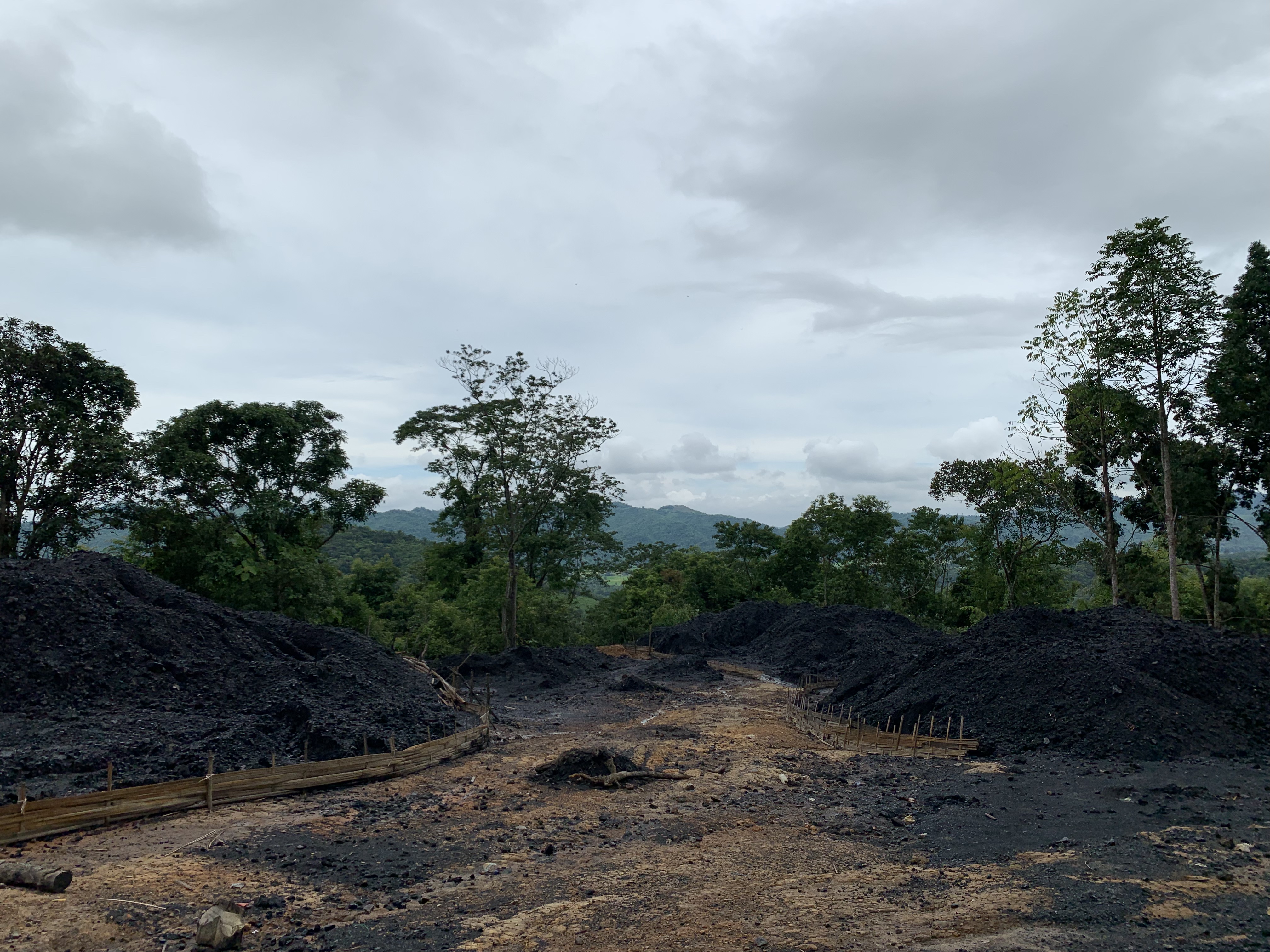
The results also underscores the complicated customary tenure system in Nagaland which is discretely being privatized by local elites. The study problematizes India’s neoliberalism of palm oil markets in this context, and presents non-market alternatives that could provide more equitable benefits.
 Osen Pongen, PhD